
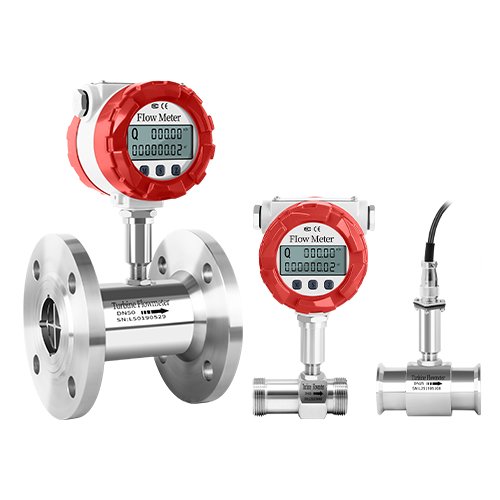
1.Working principle
The turbine flow sensor structure works by causing the impeller to rotate under the action of the fluid as it flows through the sensor. The rotation speed is proportional to the average flow velocity in the pipe. The rotation of the impeller periodically changes the magnetoresistive value of the magneto-electric converter, and the magnetic flux in the detection coil changes periodically accordingly, generating an induced electromotive force, i.e., an electrical pulse signal, with the same rotation frequency. After being amplified by an amplifier, the signal is sent to a display instrument for display.
The flow equation for a turbine flow meter is:
qv = f / K (1)
qm = qvρ (2)
In the formula, qv, qm, … represent volumetric flow rate (m³/s) and mass flow rate (kg/s), respectively.
f ……The frequency of the flow meter’s output signal, in Hz;
K … the meter coefficient of the flow meter, P/m3.
The relationship between the flow meter coefficient and flow rate (or pipe Reynolds number) can be divided into two segments: a linear segment and a nonlinear segment. The linear segment, approximately two-thirds of the operating range, is characterized by its relationship to the sensor’s structural dimensions and the fluid viscosity. In the nonlinear segment, the characteristics are significantly affected by bearing friction and fluid viscous resistance. When the flow rate is below the sensor’s lower flow limit, the flow meter coefficient changes rapidly with the flow rate, and the pressure loss is approximately quadratically related to the flow rate. When the flow rate exceeds the upper flow limit, care must be taken to prevent cavitation. TUF characteristic curves with similar structures have similar shapes; they differ only in the level of systematic error.
2.Product Features
a. Excellent repeatability, with short-term repeatability reaching 0.05%~0.2%. Due to this excellent repeatability, extremely high accuracy can be achieved with frequent or online calibration, making it a commonly chosen flow meter in trade settlement.
b. High accuracy, generally ±1%R, ±0.5%R, with high-precision models reaching ±0.2%R.
c. Outputs pulse frequency signals with no zero-point drift and strong anti-interference capability.
d. Can obtain very high frequency signals (3~4kHz) with strong signal resolution.
e. Wide rangeability, up to 1:20 for medium and large diameters, and 1:10 for small diameters.
f. Compact and lightweight structure, convenient installation and maintenance, and large flow capacity.
g. Suitable for high-pressure measurement; no holes are needed on the instrument body, making it easy to manufacture high-pressure instruments.
h. It can be made into an insertion type, suitable for large-diameter measurement, with low pressure loss, low price, can be removed without interruption of flow, and is easy to install and maintain.
3.Technical parameters
| Instrument diameter and connection method | 4, 6, 10, 15, 20, 25, 32, and 40 use threaded connections (15, 20, 25, 32, and 40). 50, 65, 80, 100, 125, 150, and 200 use flange connections. |
| Implementation Standards | Turbine flow sensor (JB/T9246-1999) |
| Accuracy level | ±1%R, ±0.5%R, ±0.2%R (custom-made required) |
| Range ratio | 1:10; 1:15; 1:20 |
| Instrument Material | 304 stainless steel, 316(L) stainless steel, etc. |
| Temperature of the measured medium (°C) | -20~+80℃;-20~+120℃;-20~+150℃; |
| Environmental conditions | Temperature -10~+55℃, relative humidity 5%~90%, atmospheric pressure 86~106kPa |
| Output signal | Sensor: Pulse frequency signal, low level ≤ 0.8V, high level ≥ 8V; Transmitter: Two-wire 4~20mA DC current signal |
| Power supply | A. External power supply: +24VDC±15%, ripple ≤±5%, suitable for 4-20mA, pulse output, R485, etc. B. Internal power supply: One set of 3.0V 10AH lithium batteries, operates normally when battery voltage is between 2.0-3.0V. |
| signal transmission line | STVPV3×0.3 (three-wire system), 2×0.3 (two-wire system) |
| Transmission distance | ≤1000m |
| signal line interface | Basic type: Hirschmann connector; Explosion-proof type: M20×1.5 internal thread. |
| Explosion-proof rating | ExdIICT6 |
| Protection level | IP65 |